Showing posts with label books. Show all posts

Wednesday, September 30, 2009

currently reading: The Discoverer by Jan Kjaerstad


recently published in the USA.

Interview

Reading the World Conversation Series: Jan Kjærstad & Mark Binelli from Open Letter Books on Vimeo.


As part of the Reading the World Conversation Series (at the University of Rochester), this event on April 30, 2009, brought together Jan Kjærstad & Mark Binelli.

Tuesday, June 02, 2009

This Week.

Wednesday night: China Mieville (British Sci-fi author) is giving a talk in Harvard Sq. (Parlour of First Church) about his book "The City and The City".

Thursday night: Raster-Noton show at the Middlesex
MAKE IT NEW
6.04.09
FEATURING RASTER NOTON
315 Massachusetts Avenue, Cambridge
617 868 MSEX

Friday night: I'm doing my radio show.

This weekend is up for grabs so far.

I'm currently reading the last Martin Beck mystery: "The Terrorists"

Wednesday, February 13, 2008

Paul Hockenos on Joschka Fischer at CES Tonight - 5pm


Tonight at the Center for European Studies at Harvard University

Wednesday, February 13, 2008

5:00 PM - 6:45 PM, Guido Goldman Room

"Back to the Barricades: Germany's Raging Debate About 1968"

Paul Hockenos, Political Analyst and Author of "Joschka Fischer and the Making of the Berlin Republic: An Alternative History of Postwar Germany" (recently published by Oxford University Press) (reviewed by Anson Rabinbach in the Nation here.)
Paul Hockenos' piece: "Left Behind: Romanticizing Germany's urban guerillas" in November/December 2007 issue of Boston Review here.

CES Special Event, co-sponsored by the American Council on Germany


Reception to follow.

Contact: Jason Beerman
Email: beerman@fas.harvard.edu

Wednesday, January 16, 2008

Janko Raven


Since I've been slightly preoccupied lately, here is a special treat.

Wednesday, January 02, 2008

Happy New Year! (reflections on the double)

A new day begins today.

But first, a moment for the past:

Recently, I finished reading The Memory Wars by Frederick Crews, which essentially dismantles the whole Freudian edifice and the 'recovered memory' movement. My head was buzzing with latent disgust with the whole Freudian project. Then I saw Francis Ford Coppola's version of Mircea Eliade's "Youth Without Youth". The film is, on the whole, pretty good. It is very faithful to the novel. However, by the same token, I wonder why would anyone want to make a film of this book. The book seems to be steeped in the application of Freudian theory (to some extent) to language. This is evidenced in the main character's project of recovery of the origins of language. The film also enlists the aid of a double. There are entire scenes where the main character (well played by Tim Roth) holds entire conversations with himself. This notion of the double or doppelgänger is reminiscent of Vladimir Nabokov's Despair, (or of Edgar Allen Poe's story "William Willson" which was filmed by Louis Malle amongst others) which was elegantly brought to the screen by Rainer Werner Fassbinder. These are just a few examples of the double in film and literature that I can think of at the moment. They are not without merit, however, in the case of "Youth Without Youth" they add another layer to the general impression that the director is going-for-broke obscurity. Prior to seeing the film, I read the novel and was prepared for the story. On the other hand, If I neglected to do so, I might have been a bit lost or at the very least would have left the film feeling I might have got more out of it had I read the book.

Monday, March 19, 2007

a bit of a wash

Last weekend went alright, as weekends go, relatively uneventful and somewhat plain. I finished Jan Kjaerstad's "The Conqueror" (review shortly forthcoming) and started "That Awful Mess on the Via Merulana" by Carlo Emilio Gadda (recently reissued by NYRB). Its a book I'd purchased used years ago after reading a reference to it in one of Jonathan Rosenbaum's film reviews (probably either in Movies as Politics or Placing Movies). The fact that its being reissued is certainly good news. It is definitely a unique "murder mystery" that more probably investigates the sickness of a society, but not without humor and a touch of the absurd. Apart from that, I finally got around to seeing the movie "Dirty Harry" as it was playing at the Brattle this weekend. Having read J. Hoberman's The Dream LifeI was more than prepared for the picture however, in retrospect, I didn't imagine the film to be so cartoonish. So much of the film felt like a very low-grade morally loaded argument. More sledgehammer tactics to make views from the periphery seem like the only sensible position to adopt. Oh well. Things are brightening up at the moment, weather-wise at least. I still have another issue of the NYRB to sift through, amongst other things. I have also been steadily transcribing other earlier journals, to be served up in some for or another, expect some of that shortly.

That's all for now.

P.S. I will be on the air this Friday, March 23, 2007.

Thursday, December 07, 2006

Das parfum by Patrick Süskind as directed by Tom Twyker


Coeli Carr from NYT reporting in IHT and also msnbc

I'm still not convinced it will make a good film. The story is compelling but seems inappropriate for the medium.

an edited extract from On Love and Death by Patrick Süskind appeared in the Guardian UK

a la lettre on the book (en francais) Leselust (auf Deutsch) and Wikipedia entry in English.

Monday, November 20, 2006

recent articles

Robert Tait in Tehran writing for Guardian UK discusses Bestsellers Banned In Iran. Susan Brink in the Los Angeles Times discusses the portrayal of health and medicine on the small screen. Benedict Nightingale writes in the Times UK on the recent work of playwright Caryl Churchill. Marc Fisher in the Washington Post says the NEA thinks NPR is making a mistake. Debra Craine writing in the Times UK of an intersting collaboration of dance and architecture. Tim Page in the Washington Post discusses the plethora of Opera reissues. Robert Kyle reports in the Art Newspaper of the government seizing work made by New Deal artists. Diane Garrett writing in Variety reports the death of VHS. Nick Hasted writes in the Independent UK of a recent trend in films that treats recent German history with sympathy. Elizabeth Williamson in the Washington Post reports on the USDA's refusal to recognize American hunger.

The CBC reports on a rare case of Scotch.

Monday, November 06, 2006

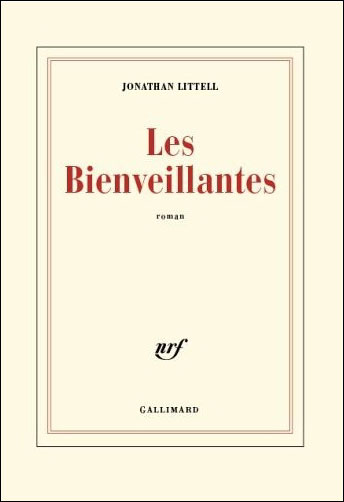
2006 Prix Goncourt - Jonathan Littell, Les Bienveillantes


There's been so much buzz about this novel. It won't come out in English until next year at the earliest -- althought 2008 is your best bet.

The better links are in French for obvious reasons:
Les Bienveillantes,
Nouvel Obs,
International Herald Tribune (from October), La Lettrine blog,
buzz littéraires, Boston Globe (AP story).

The New York Times article.

Thursday, October 26, 2006

recent articles

Come to Canada to see "Death of A Presdient". John Humphrys emphasizes the need for good grammar in the Telegraph UK. Jack Schofield gives DAB and other digital formats a good kicking in the Guardian UK. Anthony Tommasini laments the downfall of Tower Records and its classical music section in the New York Times.

Thursday, October 19, 2006

Jean-Marie Straub and Danièle Huillet

Danièle Huillet passed away recently. Obituaries: [Guardian UK] [Scotsman] [New York Times]

Jean-Marie Straub and Danièle Huillet statement at the Venice Film Festival.

Andy Rector's Kino Slang bloghas an excellent series of words and images about her.

Jonathan Rosenbaum in Senses of Cinema: Intense Materialism: Too Soon, Too Late.

A look at the book Landscapes of Resistance
The German Films of Danièle Huillet and Jean-Marie Straub
by Barton Byg.

articles of note

The most timely piece I've seen today concerns local political machinations is this piece by Joan Vennochi, Columnist for the Boston Globe. When politics trumps law its hard to be optimistic.

30 underappreciated books [Guardian UK]

The Greatest Film Composer of All Time? [Salon]
(too bad the Toru Takemitsu compilation referred to is out of print)

Arthur Marwick - Obituary [Guardian UK] [Scotsman] [Telegraph UK]- British Historian - His book "The Sixties" is one of the best histories of Counterculture during the 1960s to early 1970s.
For more information see:
The Sixties in Great Britain

The Second Law

Locus Solus (Map)

Tuesday, October 03, 2006

James Tiptree, Jr.: The Double Life of Alice B. Sheldon by Julie Phillips


At the end of the summer, I finished reading Julie Phillips's excellent biography of Alice Sheldon's life. I remember being fascinated by some of her late work, stories collected in "Tales of the Quintana Roo", when I was younger. At the time, I didn't know that James Tiptree, Jr. was actually the pen name of Alice B. Sheldon, I only felt that in reading her stories, I connected with a very intelligent mind. Julie Phillips' biography of Alice's fascinating life is recommended to any reader who is excited by a person filled with boundless curiosity. It is certainly not strictly for Science Fiction readers-- the book doesn't get to the actually stories until its final third. Alice did not start writing as Tiptree until she was 51 years old. She was born to an author Mother and an attorney Father, who invested wisely in real estate in Chicago. Her family's wealth led them to go on Safari-- Alice's first Safari took place when she was six years old. The wonder and devastation she saw there marked her life forever. By the time she was 11, she had already traveled extensively in Africa during three different Safaris. This kind of exposure to other parts of the world transformed her experience of 'ordinary' American life. She certainly could not relate to other children her age-- Phillips describes a scene where Alice's elementary school teacher is discussing Africa and cannot get Alice to sit still because she had already been there. Experiences like this provoked her and frustrated her formative years. She was also marked throughout her life by her Mother's success in writing stories for national magazines and books. Alice later went on to join the Women's Army Corps, where she-- taking a little initiative-- ended up in military intelligence by the end of World War Two. This job later became part of a new government agency after the war--the CIA. She stuck with it for three years and then left to pursue writing. Her husband worked for the Agency for the rest of his life. All of these experiences were later drawn upon to create the persona of James Tiptree, Jr. The stories by James Tiptree, Jr. are fascinating as they have an inherent skepticism regarding the nature of human progress. Phillips constantly reminds the reader at the end of most chapters how Alice's memories contributed to the substance of her stories, and how Alice's own reality exposed her larger psychological problems. Alice witnessed first hand how the United States treated women as second class citizens after World War Two. This experience made her cynically view later feminist movements in the 1970s. Throughout her life she was a witness to human violence and cruelty, whether it was in colonial Africa or in the United States of America. All of this fed into her Science Fiction stories. Tiptree was something that started as a joke for her and then became almost an emotional release at times. She was able to correspond with so many fans, publishers and other authors under this persona, that Tiptree literally provided her with a second life. Tiptree was an elaborate game for her; his actions helped her through so many depressive moods. Unfortunately, the game only led so far, by the end of the 1970s Alice was taking numerous prescription drugs and was addicted to Dexadrine (something that started when she worked for the CIA). Her quick mind could only see one way out and she entered into a death pact with her husband. Finally in 1987, she shot her husband as he slept then herself. At that point she could not deal with growing old and losing her sensibilities in a world that grew colder. Julie Phillips new biography illuminates through a thorough study of all of Alice's stories and correspondence the life of a truly remarkable woman.

For a more detailed look at this biography, I highly recommend Carter Scholz's review of it in Bookforum.

Stories:

The Screwfly Solutionby Raccoona Sheldon

Beam Us Home by James Tiptree, Jr.

The Women Men Don't See by James Tiptree, Jr.


suggested links:

The official site of Julie Phillips regarding the book in question, author interviews, excerpts, praise etc.

The Tiptree Award

Congo Journey - John le Carré writing in the Nation

Fantastic Fiction Uk bio

Publisher of "Her Smoke Rose Up Forever" tachyon

Alice's professor at Sarah Lawrence College and life long friend Rudolf Arnheim

Bioneers by the Bay: Connecting for Change


From the Chelsea Green publishing newsletter:

Eight Chelsea Green authors will speak and lead workshops at the Second Annual Bioneers by the Bay: Connecting for Change conference presented by the Marion Institute on the campus of UMASS Dartmouth, October 20 to 22. Bioneers by the Bay: Connecting for Change is an internationally acclaimed annual gathering of environmental, industry and social justice innovators who have demonstrated visionary and practical models for restoring the Earth and its inhabitants.

Participating CGP Authors
John Abrams, The Company We Keep
Dale Bell and Harry Wiland, Edens Lost & Found
Stephan Harding, Animate Earth
John Lash, Not in His Image
Lynn Margulis, Luminous Fish (Spring 2007 title)
Gunter Pauli, Upsizing and Zeri Fables
Jessica Prentice, Full Moon Feast
Matthew Sleeth, Serve God, Save the Planet
Eric Toensmeier, Edible Forest Gardens and Perennial Vegetables (Spring 2007 title)
Tim Traver, Sippewissett

Recent Articles

Fish farms kill wild salmon, study finds [CBC News] (Full Story)

Infamous French Art Thief to release memoir [CBC News] (Full Story)

Author J.G.Ballard's influence on Music [CBC News] (Full Story)

STEPHEN H. BURRINGTON, A new path for state park system [Boston Globe] (Full Story)

Monday, September 04, 2006

The Seducer (Forføreren) by Jan Kjærstad


The Seducer (Forføreren) by Norwegian author, Jan Kjærstad, was finally published in English translation in the United States this summer. It is the first book in a trilogy of his that was originally written in the mid-1990s. The book concerns the activities of television documentary producer, Jonas Wergeland. It positions itself as somewhere in between biography and fiction, or at least, that's the book's primary conceit as its language and methods exist wholly in the territory of fiction. However, the enormous presence of all the characters in the book lend it to the idea of biography, they are vivid and many times larger than life. In the beginning, in a chapter called "The Big Bang", the one event that starts the book's mechanism occurs, Jonas comes home after working on his television programme abroad, Jonas comes to his apartment in Oslo to find his wife dead on their living room floor. It is from this event that Jonas Wergeland's universe is blown apart. The book from here on in consists of past reflections, memories of childhood, family interactions, and sexual encounters in his life. These events are bracketed by chapters dealing with the subject's television programme "Thinking Big", a documentary series that focusses on an event in a famous Norwegian's life (such as Ole Bull, Fridtjof Nansen, Gustav Vigeland, Armauer Hansen, Per Spook and Knut Hamsun) and uses this to ruminate upon Norway's place in the world; it looks at the world through the prism of Norway. The seemingly omniscient narrator (and as yet, unknown) is quite critical of Norwegian life and has some startling insight into contempoary history. If you know very little of the History of Norway, The Seducer is certainly a fun and exciting way to educate oneself. It is a book full of active learning and responses to contempoary and past events. As Jonas drifts into his past, considering who could have been responsible for his wife's grisly end, his actions speak to the reader as the sign of a man with an active imagination, one who is able to examine history by his sheer contrary stance to it. Time and again, Jonas' life is marked by his conscious decision to be different, to shake things up by doing things contrary to the zeitgeist. It is usually during these moments that the narrator is able to make comments about the single-mindedness of Norwegian culture and its resistence to certain kinds of change. I found these moments of the book quite fascinating. This is not to say that the book is all history and politics-- it is the tale of a Seducer, after all. Jonas Weregeland is a seducer of the Norwegian public in watching and loving his programme and he is also a lover of women. That is to say he is the great lover of women, he does nothing to entice them to stay with him, he merely has to look in their direction, they sense his presence and must have him. This is the way numerous sexual events are described during his adolescence. Jonas is able to have intimate knowledge with the most wonderful and bizzare women (each with last name abbreviated), who in later years become experts in their fields and great champions of Norway. All of these events form a mosaic in the life of a man, a man who is bound up in his identity as a Norwegian and as a citizen of the world, at the same time that he sets himself apart from his homeland, he also illustrates that he can never escape it. This book is a charming and exciting read from start to finish. Jan Kjærstad is an author of enormous skill, his tale of Jonas Wergeland raises many questions, it makes me thirst for the second book in the trilogy.

Further information:

the Complete Review

Odin Trends in Contemporary Norwegian Literature

Publisher's information:

Overlook Press

H. Aschehoug & Co

Arcadia Books

Monday, August 21, 2006

Crime Writer to Donate 82 Sickerts to Harvard

From the Art Newspaper Bulletin:

"Patricia Cornwell, who believes that the artist was Jack the Ripper, has promised her entire collection to the Fogg Art Museum

By Martin Bailey | Posted 20 August 2006

LONDON. The crime writer Patricia Cornwell has promised to donate 82 works by the artist Walter Sickert to the Fogg Art Museum in Cambridge, Massachusetts, which is part of Harvard University. This massive collection, worth millions of dollars, was assembled while Ms Cornwell was writing Portrait of a Killer, published in 2002. The controversial book concludes that Sickert was Jack the Ripper, who brutally murdered prostitutes in London’s East End in 1888."

Full article here.

It's funny that this should come on the heels of a recent exhibition: Degas, Sickert and Toulouse-Lautrec: London and Paris, 1870–1910, Catalog of the exhibition by Anna Gruetzner Robins and Richard Thomson an exhibition at Tate Britain, London,October 5, 2005–January 15, 2006; and the Phillips Collection, Washington, D.C.,February 18–May 14, 2006(Tate Publishing, 231 pp., $55.00) and a biography, Walter Sickert: A Life by Matthew Sturgis (HarperCollins, 768 pp., $50.00) both of which were reviewed by Sanford Schwarz in the May 25, 2006 issue of the New York Review of Books.

Yale University Press also has Paintings, which was the catalogue a retrospective exhibition of Sickert's works at the Royal Academy of Arts, London in the early 1990s. Wendy Baron, director of the British Government Art Collection, has a future book coming out next year on Sickert's Paintings and Drawings which should be nearly definitive.

Tuesday, August 15, 2006

Verso Books Fall 2006


Verso’s Latest – all dates subject to change

Due in September:
John Le Carré, Brian Eno, Harold Pinter, Richard Dawkins, Haifa Zangana and Michel Faber
Not One More Death
Mike Davis City of Quartz: Excavating the Future in Los Angeles (new edition)
Antonia Lant Red Velvet Seat: Women’s Writings on the First Fifty Years of Cinema

October: Patrick Cockburn The Occupation: War and Resistance in Iraq

November:
Tariq Ali Pirates of the Caribbean: Axis of Hope
Dr. Rice in the House edited by Amy Scholder –
the list of contributors on this is pretty impressive:
Kate Bornstein, author of My Gender Workbook
Wanda Coleman, author of The Riot Inside Me: More Trials and Tremors
Thulani Davis, author of My Confederate Kinfolk
Lisa Duggan, author of The Twilight of Equality?
Eeve Ensler, author of The Vagina Monologues
Karen Finley, author of George & Martha
Laura Flanders, author of Bushwomen: How They Won the White House for Their Man
Coco Fusco, author of English Is Broken Here: Notes on Cultural Fusion in the Americas
Hattie Gossett, author of Presenting Sister Noblues
Jessica Hagedorn, author of Dogeaters
Rachel Holmes, author of Scanty Particulars: The Scandalous Life and Astonishing Secret of James
Barry, Queen Victoria’s Most Eminent Military Doctor
Arianna Huffington, publisher of Huffingtonpost.com
Margo Jefferson, Pulitzer Prize winner and author of On Michael Jackson
Jason King, Associate Chair of the Clive Davis Department of Recorded Music at NYU
Peter Kwong, author of Chinese America: The Untold Story of America’s Oldest New Community
Rekha Malhotka, aka DJ Rekha, producer of Basement Bhangra
Mandy Merck, author of Perversions: Deviant Readings
Paul D. Miller aka DJ Spooky, author of Rhythm Science
Jill Nelson, author of Sexual Healing
Avital Ronell, athor of Crack Wars: Literatre, Addiction, Mania
Faith Ringgold, author of Tar Beach
Sapphire, author of Push
Carolee Schneemann, author of Imagining Her Erotics
Kara Walker, MacArthur fellow and visual artist
Rebecca Walker, author of Black, White and Jewish: Autobiography of a Shifting Self

January 2007:
Jacques Rancière Hatred of Democracy
“As certain governments are exporting democracy by brute force, and a reactionary strand in mainstream political opinion is willing to abandon civil liberties and destroy collective values of equality, Rancière explains how democracy—government by all—is the principle that de-legitimates any form of power based on the superiority of those who govern. Hence the fear, and consequently the hatred, of democracy amongst the new ruling class. Hatred of Democracy rediscovers the ever-new and subversive power of the democratic idea.”

Beatriz Sarlo Jorge Luis Borges: A Writer on the Edge
And works in their Radical Thinkers series due to be published January 2007
Radical Thinkers II
Theodor Adorno et al. Aesthetics and Politics: Debates Between Theordor Adorno, Walter Benjamin, Ernst Bloch, Bertolt Brecht, Georg Lukacs Giorgio Agamben Infancy and History: On the Destruction of Experience Louis Althusser Politics and History: Montesquieu, Rousseau, Marx Jean Baudrillard Fragments Peter Dews Logics of Disintegration: Poststructuralist Thought and the Claims of Critical Theory Fredric Jameson Late Marxism: Adorno: Or, The Persistance of the Dialectic Ernesto Laclau Emancipation(s) Antonio Negri Political Descartes: Reason, Ideology and the Bourgeois Project Jacques Rancière On the Shores of Politics Paul Virilio Strategy of Deception Raymond Williams Politics of Modernism: Against the New Conformists Slavoj Zizek The Indivisible Remainder: On Schelling and Related Matters

Friday, November 18, 2005

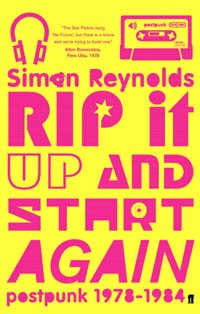
Rip it Up and Start Again by Simon Reynolds


The best new book about contemporary music history I've read is Rip it Up and Start Again: postpunk 1978-1984 by British music journalist, Simon Reynolds. Arguably the most exciting time in music since the late sixties, the postpunk era finally gets its due. This near complete version of postpunk independent music and how the subsequent labels, distribution methods and venues to deliver the new sounds came about (--and were gradually devoured by major labels and each other). This is a book that had to come out. This kind of music was only available for such a brief period of time before being trampled underfoot by a horde of commercially produced imitators. This is the music created by the generation that came of age in the mid-seventies. The sounds created were so new that independent methods were the only way to communicate their existence. People deliberately eschewed courting major labels in the name of having absolute control over their music. Reynolds chronicles all the successes and failures of the most consistently inventive (both sonically and visually) group of young artists and businessmen that tried to make a lasting impact on modern life.

To a certain extent, the simultaneous movements on both sides of the Atlantic (the book primarily deals with the United Kingdom and the United States-- deliberately leaving the project open for companion works discussing similar activity in Europe, Canada, Latin America and Japan) have left their mark on what passes for culture today. The timing of the book's release could not be more welcome, as a number of the labels mentioned recently celebrated anniversaries (Rough Trade, Mute and Les Disques du Crepuscule, among others) while primarily re-issue labels like James Neiss's Les Temps Modernes (LTM) have made a bulk of the long deleted music metioned in the book available to a wider audience. (The most recent of which being the double disc compilation of Eric Random's work titledSubliminal 1980-1982.)

Apart from filling in the gaps of my education in this expansive and somewhat personal study, this book helps to show the relationships between the people involved in the culture industry at that time. The book is really about a network for the production and dissemination of culture, that presented a near viable alternative to current methods of perception. It is not just about the artists and musicians involved but also the contributions of the label owners, journalists, and the public. Shifts in taste, budget, politics, and -- to a large extent -- technology, acted to create a unique cultural product. The emergence of so many young artists into the cultural arena at that time was astounding. A record label, such as Manchester based Factory Records was hyper-conscious not only of the quality of the music but also its packaging, often delaying releases for weeks so its delivery could achieve visual perfection. The goal amongst all these labels was to craft a--whether conscious or not--brand identity, to manipulate the public into the fold. This created a wonderfully red-hot tension between the musicians, the labels and the public resulting in the furious activity this book describes. It is this same commitment to quality and artistic integrity that fans of this period discuss to this day with the intensity of an erotic fever-dream.

Multiple criticisms can be leveled against the writer for spending too much time on certain groups and not enough time on others. While this is a valid concern, I do not see any glaring omissions in this work. This book is not only for anyone who wants to know about certain bands but it is also for those who want to understand the systems of interaction between the events discussed and how so many disparate elements influenced each other. In doing so, it provides a survey of the influential acts of the period.

One must never forget the lessons learned here of how it can be done. Applying these notions today one immediately sees distribution methods rapidly changing by the hour. Radio is still primarily dominated by commercial programming (check stopcbcpop for a current example of this). The template created by college radio in the United States (there is no such thing as an "independent music chart" in the United States--not to mention the absolute absence of a ministry of culture.) has been modified and turned into so-called alternative programming on commercial stations after someone recoginzed the viability of this demographic (circa mid-1980s). Today, the market is even further entrenched in this petty commercialism.

Then again, the knife cuts both ways, new independent labels are born daily. Nearly everyone involved in culture has a website or e-mail as technology enables things to change yet again. Disenchanted consumers of fine music are able to trace cultural activities that were previously inaccessible. In this sense, "Rip it Up and Start Again" is a worthy reference to the early days when it was all done via telephone, SNAIL mail, live performances and radio programmes (today, one is tempted to add music blogs to that list).

Our culture is on the mend, we desperately need free thinking creative people to wake up the underground once again.

XXXXXXXXXXXXXXXXXXXXX
Rip it Up and Start again
by Simon Reynolds
ISBN: 0 571 21569 6
Format: Paperback
Published: April 21, 2005
Pages: 608pp
Price: £16.99

Also due for publication in USA late January/early February 2006.

check out Simon's blog in the meantime.

Thursday, November 03, 2005

Busy Week - the end of the 30th year

It has been a moderately busy week at work so I haven't had time to finish any detailed posts lately. As far as I know I will have my current radio show back again tomorrow night from 7-10pm on WZBC.

Recently, I finished reading a first edition of Martin Esslin's book on the Theatre of the Absurd (cover depicted above is of the most recent edition). What's interesting about him is that he studied in Austria and then went to live in England during WWII. During the war he became a radio programmer for the BBC's European Service. This ties in to his general theories of the Theater of the Absurd by applying its principles not only to the stage but also to radio. Some of the authors mentioned solely created works that are meant to be heard, and not seen. The atmosphere and general concepts deriving from this use of the radio reminds me of certain horror films where the best thing about them is the sound design. The slight exception to this is Robert Wise's "The Haunting", which is well known for its excellent sound design, because it is supported by a strong story and cast.

In other news, I purchased David Sylvian's recent project NINE HORSES. It is his collaboration with burnt friedman, Steve Jansen and others (including Ryuichi Sakamoto and Stina Nordenstam). I haven't had time to listen to all of it but most of what I've heard is in a uniquely pop vein.

The other bit of music news I have concerns two new releases on Montreal-based label intr_version. Désormais has a new album out called "Dead Letters to Lost Friends" and Avia Gardner's new album is out called "More Than Tongue Can Tell". This is exciting news, expect to hear me feature these releases on my radio show in the coming weeks.
The last bit of their copy reads like this:
désormais is playing in montreal at zoobizarre, tuesday, november 8th (6388 st-hubert, www.zoobizarre.org). they (we) will be accompanying chicago's voltage. death from above 1979 for those who are way past vice? hella for the ladies? anyone? http:// www.flameshovel.com/voltage.php - you decide.

The last bit is for the local people. I'm nearly approching my thirtieth birthday (November 8). Hopefully the weather will cooperate this weekend.

Say 'hello'.